About Me

My photo
A retired Welshman living in wonderful Plymouth in SW England, I’m a family man, novice sailor and boat builder, astrophotographer and motorhomer. With a passion for all things to do with education and the sea and skies above, I have a sense of adventure and innate curiosity. I write three blogs. ‘Arwen’s Meanderings’ charts my learning to sail a self-built John Welsford designed ‘Navigator’ yawl. Look out for her accompanying YouTube channel www.YouTube.com/c/plymouthwelshboy . ‘UnderSouthWestSkies’ follows my learning journey as I take up astronomy and astrophotography; a blog for beginner’s new to these hobbies, just like me. ‘Wherenexthun’, a co-written blog with my wife Maggie, shares how we ‘newbies’ get to grips with owning ‘Bryony’ an ‘Autosleeper’s Broadway EB’ motorhome, and explores our adventures traveling the UK and other parts of Europe. Come participate in one or more of our blogs. Drop us a comment, pass on a tip, share a photo. I look forward to meeting you. Take care now and have fun. Steve (and Maggie)

Wednesday, 12 February 2025

Review - Astronomy and Astrophotography books to help beginner's get started

 Newly arrived to my blog? Want to know more about me before you dive into my posts? Why not visit the home page first and start your exploration from there: 

https://undersouthwestskies.blogspot.com/2025/01/welcome-to-my-new-astronomyastrophotogr.html

And welcome.   Welcome to 'UnderSouthWest Skies'. Thanks for stopping by. I hope you find the experience worthwhile. This blog post has been written from my own 'beginner perspective' after doing lots of reading on  various basic astronomy and astrophotography topics of interest to beginners.  In getting my head around it all, I may have got odd bits slightly wrong; but, like you, I am on a leaning journey, so please forgive any unintentional errors.  Also, just because I have gone down a particular road regarding equipment, doesn't mean that I have chosen the 'CORRECT' route!  

Meanwhile, clear skies to you. Take care and thanks for visiting   Steve aka PlymouthAstroBoy 


What makes a good book for aspiring beginner astronomers and astrophotographers? 

Good question – well I think so! And its my blog! So here goes!


·        Easy to read style and simple, clear and concise language

·        Easy to understand – you don’t need oodles of prior scientific knowledge or experience to get the basic ideas

·        Useful practical information on all those simple tips that can make such a difference to your night time experiences e.g. using your fingers to estimate the distance between stars

·        High quality photos and simple descriptions to accompany them

·        Lots of examples to illustrate core ideas and principles

·        Aimed at people like me with basic beginner’s gear


So here we go. My take on useful books for beginner’s. There are not in any order of preference etc. I will add to this list as and when I come across a book that I think fits my criteria above  - so do pop back occasionally 

‘Turn Left at Orion: Hundreds of Night Sky Objects to See in a Home Telescope and How to Find Them’        By Guy Consolmagno and Dan M. Davis

Format: Available in paperback, e-book, or spiral-bound

Print: Glossy black & white pages for bringing to the field

Mine is looking a little dog-eared isn't it? 

The first book I got on the subject. And I adore it. It comes with me on all astronomy observation sessions with my bigger telescope. It goes on every motorhome trip. Recommended to me by the team at First Light Optics as a good starter book when I purchased my Skywatcher Star Discovery 150i WIFI GOTO telescope. The book describes how objects will appear with simple telescopes and binoculars; what impact light polluted skies will have on the object being viewed compared with viewing from dark sites. Clear simple diagrams, concise text and arranged in a format which helps the beginner learn how to navigate the night sky in a sensible, effective fashion. With a mixture of easy to find objects and then more challenging targets, you can actually ‘grow’ with this book. And the mixture is good – galaxies, nebulae, star clusters, double binary stars. I’m never bored dipping into this book and it is always on my desk when planning an observation session.


One last point – the paper is glossy and withstands dew! Its spiral bound and slightly bigger than A4 in size. Basically it withstands a night outside!


‘Signposts to the Stars: An Absolute Beginner’s Guide to Learning the Night Sky and Exploring the Constellations’    by Richard J. Bartlett        Print: Black & white

Although I don’t have this book in my collection, it has been recommended to me. Essentially the book uses simple language, constellation maps, practical tips, stories about ancient myths and history to give a tour of our night sky, starting with the brightest, most easily identifiable constellations that you can see with binoculars or the naked eye. Basically, a detailed guide on how to find the constellations and features within them with easy-to-read maps.


‘Stargazing: Beginners Guide To Astronomy’   By Radmila Topalovic and Tom Kerss, Astronomers at the Royal Observatory Greenwich.

Publisher: Royal Observatory Greenwich    ISBN: 9780008196271       Paperback

I have this one in my collection but have loaned it out to a nephew. I must get it back at some stage. Aimed squarely at those beginning their astronomy journey. From telescope and binocular choice to planetary information, seasonal star charts and advice on how to plan your stargazing, the book covers lots that a beginner would want to know. It was one of the first books I picked up when I first considered a new hobby – astronomy and astrophotography – just after I retired. I got it along with another book ‘Collins Guide to the night sky’. Both obtained from the shop at the Royal Observatory, Greenwich, on a London visit. Anyway, I liked the simple clear language, informative diagrams and photos.


‘Collins Guide to the night sky – A month by month guide to exploring the skies above Britain and Ireland’   Publisher Collis and Royal Observatory Greenwich.

I have got one of these books every year since I started the hobby and it forms part of any astronomy/astrophotography session planning I do. Essentially it is a month-by-month guide to the planets, stars and constellations you can each night in a month across a year, from the northern hemisphere. A mixture of clear concise text, calendar lists, celestial charts and diagrams help me map the movement of the stars and the moon cycle over the month.  


‘Moongazing – Beginner’s guide to exploring the moon’   By Tom Kerss   Publisher: Collis and Royal Observatory Greenwich

Another from the Collins ROG stable which I really like and refer to often. Detailed moon maps, the history of lunar observation and exploration; what the moon is made of and more. How to draw moon sketches, choosing a telescope to observe the moon, and a comprehensive section on astrophotography tips and skills for moon photography. I learned loads about eclipses and blue moons! And finally understood what is meant by ‘conjunction’ and ‘occultation’! The photographs are fascinating. I love the lunar atlas bit – photos an accompanying maps in two page segments – details about surface features. With my smaller table top dobsonian, I can see some moon gazing nights materialising during the summer when we are motorhoming. I have yet to do much lunar observation or astrophotography but when I do, this book will be an excellent starting point.


‘Guide to imaging the moon’   by Dave Eagle FRAS    www.star-gazing.co.uk  Paper back

Another book I picked up but haven’t fully used yet. Dave has produced a series of guides – I have a few and will list them below. In this guide he covers DSLR and webcam imaging of the moon. From imaging to stacking them, techniques on noise reduction and sharpening, its practical with good step by step tips and techniques. He refers to using Autostakkert, Registax and photoshop for image processing.  Moon astrophotography is on my list of things to start exploring this year.


‘The Backyard Astronomer's Guide’    by Terence Dickinson and Alan Dyer

I’ve been told to add this book to my collection soon. Why? Simple clear and concise information – from choosing a telescope to capturing the cosmos! Stunning images and stellar advice on choosing astronomy equipment. Sky tours, star charts and more. Latest edition is bang up to date on observation techniques and equipment and has five brand-new chapters, including three essential essays on binocular, telescope and Moon tours by renowned astronomy writer Ken Hewitt-White. From LED lighting technology, WiFi-enabled telescopes and the latest advances in binoculars, telescopes and other astronomical gear to new techniques for observing the Sun, the Moon and solar and lunar eclipses. And new sections on dark sky reserves, astro-tourism, modern astrophotography and mobile phone astrophotography.  It is on my wish list!


‘Photographing the night sky – Techniques, planning and processing’    by Alyn Wallace

Publisher – www.fotovue.com

The most expensive book I have ever purchased and worth absolutely every single penny, a thousand times over!  I can’t begin to sum up what an influence this book has been on my skills development. Comprehensive – an inadequate summary! If you are a beginner to landscape astrophotography, then this is the book for you! 

Detailed, informative, highly readable. Stunning photographs and illustrations. Clear, concise explanations – nothing overwhelming but everything aimed at you assimilating and understanding concepts quickly. Is it an encyclopedia? Yep, think so! From equipment, settings and multiple exposure techniques to astronomy basics, location scouting and photo post editing techniques, I am always referencing some chapter monthly! Complex topics explained in an easy to grasp manner have had immediate impact on my milky way landscape images. Is it making me a better night time landscape imager? Absolutely!


‘Night sky photography – from first principles to professional results’   by Adam Woodworth  Publisher: Octopusbooks/Illex Press

Another book which has taught me so much! And a book I constantly dip back into regularly. This is a book, that like Alyn’s above, takes you through everything you need to know – step-by-step. From what gear you need to simple techniques to master when out in the dark. I like his post editing workflows – they have helped me enormously. The book is well written and easy to understand. Explanations are simple, concise, informed and well-paced. Stunning photographs throughout. Heavily milky way focused but that is what I wanted. There are sections on shooting the northern lights as well. From gear to software, settings to post editing techniques – this book is great for beginners to nightscape astrophotography.


‘The Stargazer’s Handbook – The definite field guide to the night sky’  By Giles Sparrow  Publisher: Quercus books

I love this book. I pick it up in my quiet downtime moments just to browse. It is a first port of call when I am looking for new deep space objects to capture.   Complete maps of constellations and celestial bodies. Month by month guides. Beautiful, extraordinary photography – over 400 images. You take this book out with your binoculars on those warm, clear nights! Every star, constellation and nebula is fully illustrated and comes with a detailed annotated star chart. Infact, what I like most, is it is completely arranged by constellation. Love this book.


‘Nightwatch: A Practical Guide to Viewing the Universe’    By Terence Dickinson

This is a book that is a general introduction to astronomy. And its on my Christmas list for 2025. Although up to now, I have focused on my astrophotography, I know it is time to start exploring the astronomy side of things more.

Anyway, this book has been recommended to me. Stunning photographs, charts of famous stars to seek out with binoculars or small telescopes. Useful equipment section as well. Clear, concise and simple language make it an easy read. Explanations are relatable, easy to follow an understandable.  Great sections on the moon and planets. Even a chapter on astrophotography and sections about the latest digital computerised smart telescopes. A huge amount of information condensed into bite sized chunks. 

Tuesday, 11 February 2025

Beginners guide to keeping an astrophotography/astronomy log book

Newly arrived to my blog? Want to know more about me before you dive into my posts? Why not visit the home page first and start your exploration from there: 

https://undersouthwestskies.blogspot.com/2025/01/welcome-to-my-new-astronomyastrophotogr.html

And welcome. 

Welcome to 'UnderSouthWest Skies'. Thanks for stopping by. I hope you find the experience worthwhile. This blog post has been written from my own 'beginner perspective' after doing lots of reading on  various basic astronomy and astrophotography topics of interest to beginners.  In getting my head around it all, I may have got odd bits slightly wrong; but, like you, I am on a leaning journey, so please forgive any unintentional errors.  Also, just because I have gone down a particular road regarding equipment, doesn't mean that I have chosen the 'CORRECT' route!  

Meanwhile, clear skies to you. Take care and thanks for visiting   Steve aka PlymouthAstroBoy 


Well, some people do. Others don't. Which are you?

I'm the former - I keep notes on everything. I have hundreds of used notebooks upstairs in my study - all the ones from when I was a teacher. Then there are my note books for the various blogs and YouTube channels I have.  Don't fret for me - I only have one on the go at any one time. But I keep hold of them - no idea why, but there we go!  

So, the big question - 'What's the point of keeping an astrophotography and/or astronomy notebook?' 

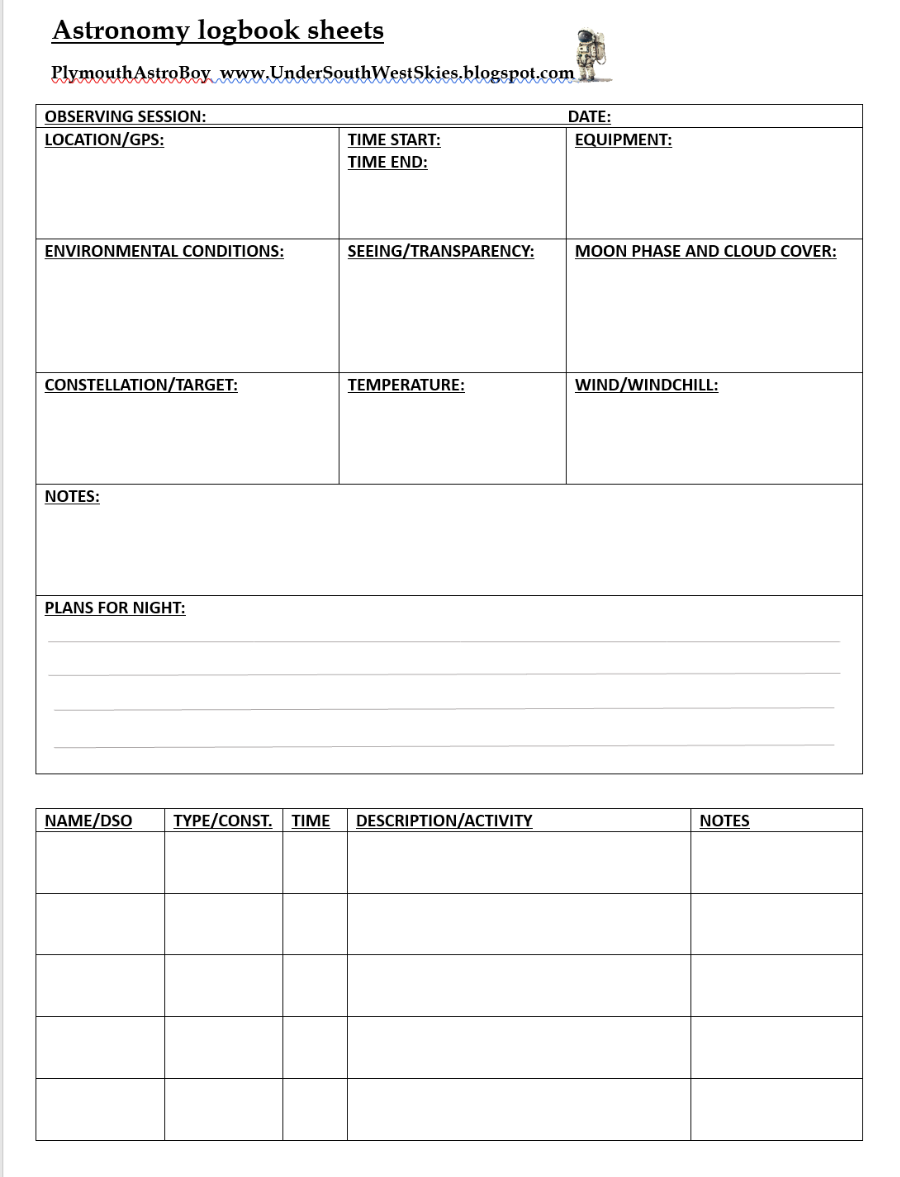
Page 1 of 2 that I use in my Astronomy log book 


Memories! Developing one's observation skills - of the night sky; of the weather; of the activities done by myself and with others. 

A diary of your experiences and learning journey (normally why I keep a logbook of some form). What you have done, seen, learned! How you have grown in skills and understanding. What you achieved and how you felt on those cold nights when your rig frosted over and you lost contact with your hands and feet.  A memory bank - what the first deep space object was that you saw and drew all those years ago! Big picture overview details easily remembered; little picture minutiae details, easily forgotten. A record of deep space objects observed that you can return to easily and compare notes from a more recent observation session against. What's changed? How have your viewing skills since last time improved? 

Page 2 of 2 for my Astronomy log book 


My dinghy cruising blog, for example, ran for fifteen years with many subscribers and tens of thousands of page views every year. I kept a dinghy cruising log book of every single time afloat. My dinghy cruising YouTube channel - a visual diary of fifteen years afloat through over 270 odd videos. stories, adventures, skills development, personal reflections, hardships, accidents, capsizes, successes, wildlife encounters - all there as memories. 

This was how my astronomy log book started out way back in 2021

Above are my astronomy log book pages. I could buy one but I just made up my own and I print them off as and when and then stick them into a big spiral bound A4 book. I think they get most of the details of what I want to record. I can expand on some details e.g. mentioning fog, dew, pollution, turbulence etc. Encounters with wildlife - recently its been foxes, hedgehogs, sheep and wild ponies!  Starlink satellite chains! 

There are appropriate places in which to record note about DSO's - RA and Dec details, brightness, constellation details etc. 

Anyway, hope these help. I am sure there are software programs that will do it but I'm not one for those. I gain greater enjoyment from writing during the observation/astrophotography night. 


My astrophotography log book is hand written as and when I go out

With regard to my astrophotography logbook - it's more a jotter than a log book. Similar things get written in - a plan for the night; shooting details e.g. how many lights, at what exposure length etc. 

I guess that over the years I will build up a series of these to look back over, which will be fun. 

If you have a particular design for your log book why not share the details with us  - drop us a comment below. 

Saturday, 8 February 2025

Beginner's guide on how to set up and use the Skywatcher Star Adventurer 2i wifi tracker

Newly arrived to my blog? Want to know more about me before you dive into my posts? Why not visit the home page first and start your exploration from there: 

https://undersouthwestskies.blogspot.com/2025/01/welcome-to-my-new-astronomyastrophotogr.html

And welcome. 

Welcome to 'UnderSouthWest Skies'. Thanks for stopping by. I hope you find the experience worthwhile. This blog post has been written from my own 'beginner perspective' after doing lots of reading on  various basic astronomy and astrophotography topics of interest to beginners.  In getting my head around it all, I may have got odd bits slightly wrong; but, like you, I am on a leaning journey, so please forgive any unintentional errors.  Also, just because I have gone down a particular road regarding equipment, doesn't mean that I have chosen the 'CORRECT' route!  

Meanwhile, clear skies to you. Take care and thanks for visiting   Steve aka PlymouthAstroBoy 


This blog isn't about the SWSA  - its not a review of its components, advantages and disadvantages - for that go to this website as a starter: https://astrobackyard.com/sky-watcher-star-adventurer-pro-review/

Neither is it a detailed guide on using it - the tracker comes with a handbook which is detailed. When I first got the Skywatcher Star Adventurer 2i pro, I found the manual was informative and helpful but the way it was written mean't I couldn't assimilate and remember it all. More to do with me rather than the actual manual itself. In consequence, it took me ages to get to grips with how to use the tracker properly. There were a few videos which helped enormously and I have put these below - there for any visual learners like me 😄

Learning how to take flats (or not!!) during a very cold night 
The observant will notice that it isn't the star adventurer original base! One of the very first things I gleaned from other users - replace the base with the superior Williams Optics wedge. Expensive, but an absolute game changer in terms of accuracy when polar aligning

So, one of the first things I did was write myself a little aire memoire which I still use occasionally. If like me, you get terribly excited when a very rare clear night suddenly materialises, it is easy in all the enthusiasm, to forget something! At times I am so excited on reaching a destination with no clouds that I rush the set up and miss things out. The check list comes in handy then to back track and tick off that I have done everything. Its my way of making myself slow down and be methodical.  A good lesson in life sometimes! 😉

So yes, today's blog post is about a checklist for those of you who are, at times, like me, cognitively challenged in the memory department! It IS NOT about step by step accounts of precise what to do and HOW to do it! 

I have a book that goes with me - it has my check lists in it and also acts as a notebook for me to complete an astrophotography log for each imaging night 


I use my tracker for both my milky way landscape astrophotography and my Deep Sky astrophotography and whilst most of the set up is the same, there are differences, depending on whether I am autoguiding or not and on whether I am using DSLR and lenses or DSLR and small refractor telescope. 

Over time I have been less reliant on the check list. This is because I regularly practise assembling it in my lounge on rainy days and walking myself through it all until it becomes familiar. Sad but true! 😁 

Since taking this photo, I have upgraded my storage crate for the tracker (see below)  - a new cut out foam block with specific cut-outs for each element of the tracker. Much more secure and protected. 

In this shot  - left is my pouch for my tablet. Right is my astronaut case for my DSLR. Both of these have been made for me by my wonderful wife. They are basically padded cases. 
The crate contains the foam insert that came in the SWSA 2i pro packaging and I have butchered this to better fit my SWSA rig. 

And whilst we are briefly looking, unintentionally, at my storage - here is my Zenithstar rig ready to go. It is actually better padded with bubble wrap that it first seems. There is also a huge bubble wrap pad that fits over the top before the lid gos on. 
This is the 'carry it in the car/motorhome' packing -when I know I'm not having to do anything than open up the door/boot lid and assemble it straight out alongside the vehicle. 


But as I said earlier, occasionally if something isn't working on the night, I go back to the list and retrace my steps. It has saved me a couple of occasions; like when I have it set to APP and I'm not actually using the app because I am autoguiding and need it just in normal 'Star' icon position for sidereal tracking. Yeah I really have done that on at least three occasions! 😭😄


Prefer it in a visual but less detailed format? 

Anyway, I hope the list is useful to you if you are new to trackers and starting out with the SWSA 2i. Read the handbook, watch the videos, use this list to start with. Good luck, have fun and stay safe out there. Clear skies 

Steve aka PlymouthAstroBoy 


These are the videos that I found helpful when first starting out with the SWSA 2i. 

This is the first video in a series of three or four about the star adventurer and are a really good detailed insight into how to get the best from this tracker


Recently, Peter has put up one of the videos which used to be part of his buy-in course package - its now, thanks to his kindness, freely available and gives great insights - including on using it with an autoguider system 

And yes, proof! I really do spend time assembling the rig in the lounge on rainy days! 😁


Friday, 7 February 2025

Imaging session - M51 Whirlpool Galaxy

Date: 5th February 2025

Location: Yelverton RAF Harrowbeer old airfield

Equipment:  Canon 800D, Zenithstar 61ii, SWSA2i, ASIair mini, ZWO 120mm guide cam, RVO 32mm guide scope 

Shooting information:  lights - 40 x 120" (1hr 40mins integration time); calibrations frames - x15 of each

Shooting conditions: moon 45%; 3C to 1C without windchill; gusts of wind 15 mph; normal winds 3- 6 mph

Shooting target: M51 Whirlpool galaxy

Post editing: stacked and processed in SIRIL and Affinity Photo 


Bands of cloud from the north east were stubborn and slow to clear 


It isn't the first time I have aimed my little telescope at this target. I did so last year as well. That image can be seen below: 

My first effort at the start of 2024

Not happy with that first go, I went out again later in 2024 and managed to get this image: 

My second effort February 2024

There is no doubt in my mind that I am getting to grips with acquiring the data. I am just not spending enough time on acquisition.

However, my post processing skills still suck and 2025 will be the year in which I finally get to grips with mastering the subtleties of Affinity Photo.


So here is my image from the other night: 


My latest effort February 2025

Insufficient integration time for a start me thinks! 

This one came at personal cost. It was so cold once you factored in windchill. Although clear skies were forecast from 9pm, it wasn't until 2345 that I was able to get a sustained break in the clouds to allow some continuous imaging. 


As the skies cleared, the wind gusts became more frequent. I had to lose about 15% of my lights due to trailing, which was caused by these gusts. My autoguiding , was at times, all over the place, as can be seen on these screen grabs. 

The initial steps to guiding went well tonight 

On average I was getting around 0.7 on the RA guiding line but frequently I'd get spells like this when it jumped and peaked all over the place

In my beginner's mind, I am putting this down to wind gusts but I can't be sure. Did I not Polar Align accurately enough? I got the green smiley face and my initial PA on the SWSA was pretty spot on. I don't think it was vibrations as I was using anti-vibration pads beneath the tripod legs. 
My only other thought is this - is it connected to what I thought might be damage to my clutch system? (see a previous post from a few days ago). I don't think it is, but I cannot be 100% sure. 


So what are the basics we need to know about M51? 

M51, the Whirlpool Galaxy, is a spiral galaxy in Canes Venatici. 
Co-ordinates: R.A 13h 30m 56.58s   Dec +47d 03' 55.5"

Very conspicuous and well known, M51 interacts with a smaller neighbour NGC 5195. 
Charles Messier discovered M51 in 1773, describing it as a 'faint nebula without stars'.  
The actual whirlpool pattern wasn't seen until 1845 by Lord Rosse through his 6' reflector telescope. Having made a very accurate painting of M51, the galaxy is sometimes referred to as 'Rosse's galaxy' or 'Lord Rosse's question-mark'. 

A circumpolar object for most northern hemisphere observers, it reaches its highest altitude in the early morning hours throughout winter and into spring. 

You can see M51 through a good pair of binoculars at a dark sky site. It has a bright core and a large faint halo with faint spiral arms. 

M51 is comparable to our own Milky Way galaxy in size, mass and luminosity. The spiral pattern is believed to be the result of the close interaction between M51 and NGC 5195, when the latter passed through M51's main disc some 600 million years ago. 

The Hubble telescope investigated the centre of M51 and concluded that there existed a black hole surrounded by a ring of dust. 

Red light head torches - wonderful invention! 


Wednesday, 5 February 2025

Equipment - My first telescope the Skywatcher Star Discovery 150i and the first night out with it

 Newly arrived to my blog? Want to know more about me before you dive into my posts? Why not visit the home page first and start your exploration from there: 

https://undersouthwestskies.blogspot.com/2025/01/welcome-to-my-new-astronomyastrophotogr.html

And welcome. 

Welcome to 'UnderSouthWest Skies'. Thanks for stopping by. I hope you find the experience worthwhile. This blog post has been written from my own 'beginner perspective' after doing lots of reading on  various basic astronomy and astrophotography topics of interest to beginners.  In getting my head around it all, I may have got odd bits slightly wrong; but, like you, I am on a leaning journey, so please forgive any unintentional errors.  Also, just because I have gone down a particular road regarding equipment, doesn't mean that I have chosen the 'CORRECT' route!  This particular post below is a good example - in hindsight - I might have chosen a different telescope and mount to start with. But in a mad rush of over-enthusiasm.........

Meanwhile, clear skies to you. Take care and thanks for visiting   Steve aka PlymouthAstroBoy 


This blog was written a few years ago, sometime around 2021,  and published on my Arwen's Meanderings  and 'wherenexthun' blogs. I have now transferred it here to my new UnderSouthWestSkies site. 


My new telescope finally arrived last week. It has been stuck on a ship - trapped in the Suez Canal! No seriously, it has! 

Anyway, it is a Skywatcher Discovery 150i GOTO newtonian telescope with SynScan app on smartphone to control its movement and access the database. It duly arrived in two boxes, one containing the optical tube assembly and the other - the tripod, eyepieces, and single arm GOTO mount. I also got a red dot finder and a metal tray to sit between the tripod legs. 

Regular readers will know that I have taken up astrophotography and astronomy. My intention is to do them both when out on overnight up-river voyages in Arwen, my cruising dinghy. There are one or two lovely, relatively dark sky, spots up the Lynher and Tamar and on gentle breeze days I might take either the Ioptron skytracker pro or the telescope with me. I am just working on how to safely keep them waterproofed and securely stored out of harm's way in Arwen. There again I might only take the skytracker as that is lightweight, small and portable.  (You can read about that by referring back a couple of posts).

The telescope will also travel with us in our Motorhome Bryony! 

So, over the last few nights of clear skies I have been down to a local beach spot where the light pollution from the city is less. I can sit in the boot of the car, with the boot door raised above me and have telescope and ioptron tracker set up on tripods outside.

It has, putting it mildly, been an interesting learning curve these last few nights. A good job I am a life long learning fan! Thus far, I have made some simple basic errors but had lots of fun and some good learning experiences:

  • tripping over the tripods or knocking them when moving around - I am innately clumsy
  • not getting the tripods level at the start
  • not adjusting and calibrating my phone correctly so that the GOTO mount was out in its own tracking of stars and galaxies - that was a frustrating hour and a half trying to work out why the telescope pointed 90 degrees away from the object I had commanded it to GOTO 😕
  • forgetting to set my phone to a red night setting, so every time I referred to one of the apps - it lit up bright white and ruined my night vision, which I had spent the last 30 minutes building up
  • not calibrating the skytracker correctly so that the 200 x 2 minute photos I took were all out with elongated stars - that's over two hours of my life I won't get back again 😭
  • watching the power cable from the powertank to the GOTO mount, wrap itself around the tripod as I made the telescope change various directions - that was a cable knot that took some sorting!
  • not being able to set the camera and lens to the correct orientation because the first ball head mount I used was too small and unbeknown to me, kept slipping during the three hours that I tried to take photos with an intervalometer 😩. That was 400 photos into the digital waste bin!
  • trying to get my head around the various eyepieces and how to use them in conjunction with Barlow lenses
  • trying to remember and recognise the key constellations and marker stars
Lesson learned - do just on thing on a night - either visual astronomy using the big telescope OR astrophotography using the tracker. There will come a time, I am sure, when my poor brain will be able to handle both on the same night, but it isn't now; nor the foreseeable future based on last night's performance! 

Last night my neighbours in the car park proved entertaining. For several hours they had a small BBQ between their two converted campervans. It was full of dancing orange flames and they sat around it singing, playing sitar music and the bongos and chanting. It got fairly wacky but chilled around 12.20am when one of them continually tried to get into their van without opening a door. When she passed out, I wasn't sure whether it was due to drink, concussion or the copious amounts of weed consumed. Either way, her companions carried her into the van and all seemed well. They put out the BBQ fire and everything was quiet for the rest of the night.

Millennials eh? Such lightweights! In bed by 1.00 am!


So why did I buy this telescope? 

I'd read a very review of it in a 'Sky at night' magazine article. 

So a few details: 

  1. a 150mm aperture, focal length of 750mm - F/5 focal ratio - so it will work for planets and deep sky gazing
  2.  with the 25mm eyepiece that gives a magnification x30; the 10mm piece gives x75
  3. mount is powered by 8 AA batteries or a 12v power tank plugged into a power port. It is a single Alt-az type. Quite sturdy looking and held onto the tripod by three bolts. 
  4. the mount is driven by a syn-scan app on my smartphone which gives access to a database of celestial bodies as well  
  5. the red dot finder is a zero magnification one which sits atop the optical tube
  6. the tripod is strong aluminium and well made
  7. to start it up - the telescope is set to level and pointing north; I then carry out a 3 star alignment procedure  

One of the things that attracted me was the GOTO capability. I could do some visual astronomy immediately and not worry about having to navigate complex star charts. I was told that using a smartphone attachment piece I would be able to image the moon, Pleiades and the Orion Nebula, although so far, despite my best efforts, this hasn't happened yet. But I think it is more to do with my smartphone!  Similarly, although told I could link my telescope to Sky Safari on my smartphone, I have yet to work that out. there is a setting for it in the mount but I have yet to find it. 

There is a port on the mount for adding a synscan hand controller should I want to but actually I liked the idea of using my smartphone to drive the scope. Switch on the mount and it creates its own wifi network. The synscan app, as I said earlier, has a great database. 

The optical tube assembly is quite light and easy to transport off the tripod, which I quite like. 

Concerns: well immediately I think that it is unlikely to reach focus using my DSLR and I am not convinced that the focuser tube could hold the weight of a canon 800D anyway. So proper astrophotography is out, but I sort of knew that already! 

Look, I know its a beginners telescope - but that's what I need at this moment in time. The videos below helped me a lot. For the budget I had, I think its a good start. I don't know whether astronomy will become my new passion or not - so not breaking the bank and then discovering I don't enjoy it - were major considerations in my choice! 


Equipment - My first star tracker, the Ioptron Sky Tracker Pro

 Newly arrived to my blog? Want to know more about me before you dive into my posts? Why not visit the home page first and start your exploration from there: 

https://undersouthwestskies.blogspot.com/2025/01/welcome-to-my-new-astronomyastrophotogr.html

And welcome. 

Welcome to 'UnderSouthWest Skies'. Thanks for stopping by. I hope you find the experience worthwhile. This blog post has been written from my own 'beginner perspective' after doing lots of reading on  various basic astronomy and astrophotography topics of interest to beginners.  In getting my head around it all, I may have got odd bits slightly wrong; but, like you, I am on a leaning journey, so please forgive any unintentional errors.  Also, just because I have gone down a particular road regarding equipment, it doesn't mean that I have chosen the 'CORRECT' route!  

Meanwhile, clear skies to you. Take care and thanks for visiting   Steve aka PlymouthAstroBoy 


This blog post appeared on my www.wherenexthun.blogspot.com around 2019. I was just thinking of starting a new learning passion - astronomy and astrophotography. With budget constraints, this was all I could afford at the time.  Anyway, here was one of my first posts about using it. 


Doing astronomy and astrophotography from a motorhome - using an Ioptron Skywatcher Pro

 As well as a telescope for my newly found hobbies of astronomy and astrophotography, I have just received an Ioptron Skytracker Polar Pro as well.

It’s basically a compact, motorised, one axis mount which precisely tracks the stars as they pass overhead of you. It has a maximum payload capacity of 6.6lbs, weighs 2.5 lbs and is made of die-cast aluminium covered by ABS plastic. With an internal battery (2000 mAh) which is rechargeable using a micro-USB cable, it has 4 tracking speeds (1x sidereal, 1/2x for sky and landscape, and then solar and lunar. They can all work in both hemispheres which is great as I travel a lot. There are also forward and reverse slew modes). On one charge it should go 24 hrs! I haven't used it in the cold but I suspect that not using AA batteries as well may prove to be an emerging issue in the future - we will see. 

And when I mean compact, I really do mean compact. It fits in my hand and the bottom compartment of my camera bag with no problems.

Well packaged, it arrived in a padded bag which was a snug fit. I struggled to get it in and out but I guess that means it won’t shift around!

Unpacking the kit, I discovered the mount, an alt-azimuth base, a brass 3/8 and ¼ inch threaded ball head mount plate, a charging cable and the polar scope. People will also need a ball head to mount their camera to the tracker. I just used one I had off my Joby Gorillapod [although since originally writing this post I have now bought a Joby Gorillapod 5lb ball head which is much more suited to the task].

Source: Facebook market place 

I’ve spent a couple of hours fiddling around with it working out how to set the latitude angle and also how to alter the horizontal plane as well. The polar scope has proved troublesome though. This little scope has a scale reticule inside it which you use to line up the tracker with Polaris in the night sky. Sadly, my reticule seems to be at a 90-degree angle to what it should be which does my head in when trying to do the simple alignment adjustments needed. I have contacted Rother Valley Optics and Ioptron to see if one of them can send me a new one [Ioptron never got back to me – great customer service, eh? RVO’s however, immediately told me to send it back and they would fix it for me.  In the end, I have just lived with it and trained my brain to ignore the 90-degree twist].

The alt- azimuth base is a bit of an issue. I don't find it that precise and it feels slightly flimsy if I'm honest. I suspect this will be an issue that irritates me. 

Having used it a few times now, I have discovered it is a clever bit of kit. It is relatively easy to set up and I can do it now in ten minutes. 

Source: FaceBook market place 

For a really detailed review and tutorial on how to use it, I found Peter Zelinka gave me the best advice and insights: https://www.peterzelinka.com/blog/2018/4/ioptron-skytracker-pro-review

Also very insightful - Trevor Jones - https://astrobackyard.com/ioptron-skytracker-pro-review/

 I can take longer exposures of the night sky using one of the four tracking modes available. Star trailing has been reduced. Sadly, I suck at post processing and this is where I will need to concentrate my efforts over the next few months!

some of my very first images using this tracker - my post editing skills absolutely suck! 

And now you can see why we have gone to the trouble of up-plating Bryony! It was the tow bar, the e bikes, the bike rack, the telescope and the camera gear wot did us in. Maggie would like to point out that when we recently went through all the stuff we could ditch out of Bryony, all she had that was hers …. were her clothes and ………. a tiny 12v hair dryer!

I am still trying to live this down!

If you are out and about in your motorhome or waiting for yours to arrive, stay safe, take care out there and have fun. I will let you know how I get on with the tracker (and the telescope). This could be the start of a new interest group: ‘motorhoming astronomers!’

Clear skies, live long and prosper motorhoming buddies!

Steve


This is the equipment that I use for my basic astrophotography:

 Canon 800D DSLR with 18 – 55mm and 55 – 250mm kit lenses

 Canon 50 mm F/2.8 prime lens

 Canon 24mm F/2.8 prime lens

 Intervalometer

 Carbon Fibre tripod

 Ioptron Skytracker Pro


getting slightly better at post processing 

The Ioptron Skytracker Pro

M45 Pleiades or ‘The seven sister’s  Bright stars surrounded by blue space dust clouds

Ioptron Skytracker pro with Canon 800d  200mm lens at F/5.6 ISO 800


Tuesday, 4 February 2025

Beginner's guide to using a GoPro for night time imaging, timelapses and shooting the aurora

 Newly arrived to my blog? Want to know more about me before you dive into my posts? Why not visit the home page first and start your exploration from there: 

https://undersouthwestskies.blogspot.com/2025/01/welcome-to-my-new-astronomyastrophotogr.html

And welcome. 

Welcome to 'UnderSouthWest Skies'. Thanks for stopping by. I hope you find the experience worthwhile. This blog post has been written from my own 'beginner perspective' after doing lots of reading on  various basic astronomy and astrophotography topics of interest to beginners.  In getting my head around it all, I may have got odd bits slightly wrong; but, like you, I am on a leaning journey, so please forgive any unintentional errors.  Also, just because I have gone down a particular road regarding equipment, it doesn't mean that I have chosen the 'CORRECT' route!  

Meanwhile, clear skies to you. Take care and thanks for visiting   Steve aka PlymouthAstroBoy 


You will have already gathered from a quick perusal of this blog, that on almost all of my sessions, I will complete a timelapse using my GOPro Hero 9. 


My very first night time video using a GoPro on one of my first astronomy/astrophotography sessions
This was way back in 2021 sometime

And some more recent efforts 


I haven't yet started to use my Canon 800D for timelapses, but that time will come during this next milky way season. 

Anyway, returning to my GoPro Hero 9. 

It has the facility to set up custom night time lapse setting programmes.  So here are my settings for various types of night time shooting with a GoPro.  I suspect they will apply to most GoPro's from Hero5 upwards. 

Timelapse settings: 

Firstly, turn off autofocus and then if there is a moon present/moon NOT present  

  • FORMAT -  video/video
  • RESOLUTION - 4k/4k
  • INTERVAL - auto/auto
  • SHUTTER - 20"/20" (I am thinking of raising this to 30")
  • OUTPUT - RAW/RAW
  • SCHEDULED CAPTURE -  off/off
  • DURATIONS - no limit/no limit
  • TIMER - off/off
  • E.V. COMP - N/A N/A
  • WB - 4000k/4000k
  • ISO min - 400   800/1600
  • ISO max - 800   800/1600
  • SHARPNESS  - high/high
  • COLOUR  - GoPro/GoPro
  • PROTUNE - on/on 
  • ZOOM - x1
  • LENS SETTING - linear/linear (although I suspect wide might be better as it will let more light in)

Settings for Milky Way images:
  • FORMAT - photo mode (night mode)
  • INTERVAL - auto
  • SHUTTER - 30"
  • DURATIONS - no limit
  • SHARPNESS - low
  • VIEW - wide
  • TIMER - 3"

Settings for obtaining star trails: 
  • WB - 6000k
  • SHUTTER - 30"
  • INTERVAL - auto
  • VIEW - wide
  • TRAIL LENGTH - long
  • SCHEDULED CAPTURE  - off
  • DURATION - no limit
  • TIMER - 3"
  • MODE - timelapse
  • MODE - continuous drive
  • ISO - 800 to 1600
  • QUALITY - 4k
  • SHARPNESS -  low
  • COLOUR - natural

Settings for general night photos:
  • SHUTTER - 10" (if waning moon - 30"/ISO 1600; if bright moon and lots of shadows  - 20"/ISO 800 or 10"/ISO 1600) (if no moon - 30" 4000K  800/1600 ISO, low sharpness) 
  • WB - 5500k (if moon - 4000k)
  • ISO - 800 (but see moon settings above) 
  • SHARPNESS - high 
  • PHOTO MODE - night
  • TIMER - 3" 
Can you shoot the northern lights with a GoPro?
Well yes you can! Surprisingly! 


Here were my settings: 

  • MODE - nightlapse
  • WB - 3200k
  • INTERVAL - continuous
  • MEGAPIXELS - 12mp wide
  • ISO min 400 max800
  • SHARPNESS - low 
  • SHUTTER SPEED -  start at 10" to 20"; but could go 20" to 30"
  • PROTUNE  - on
  • EV COMP  - off
  • SPOT METER - off
  • COLOUR - GoPro
If you want to film the northern lights with your GoPro - I haven't tried that by the way - but at a guess I'd start with these settings: 

  • COLOUR - flat or GoPro
  • WB - 3200k as starting point
  • FRAME RATE - 1080/24 
  • SHUTTER - start with auto
  • ISO - max 800


Some points to note: 
  1. If you are doing an entire session - you will need to plug your GoPro into an external power bank. One normal battery isn't going to do it! You will need to remove or unclip the battery compartment door - so this is not a 'do it in the rain' technique 
  2. Set your GoPro up on a small tripod for stability and think carefully about what it is you want to record - I opt for lowish viewpoints/perspectives so that I can include me, my astronomy rig and the night sky passing overhead. My camera is normally angled upwards 30 degrees or so. 
  3. experiment with shutter speeds - I find that 30" is just a little too fast - may be I should opt for 15" instead. Five hours gives me around 90 - 120" of video at the end
  4. ensure that something will be moving in your timelapse - the stars, clouds, you, your mount! The slower the movement in something the better - it becomes more noticeable in the final video. 

This website gives some further option recommendations: