Sunday, 16 February 2025

Imaging tutorial: Beginner's guide to taking your first milky way photo

 Blogger isn't always the most intuitive platform to navigate - but it is free and simple to use and manage. 

To help you find information quickly on this blog, you can


Beginners guide to getting your first milky way photograph

One of my ambitions is to improve my night time landscape astrophotography. particularly my milky way imaging. Last year I dabbled but learned lots. This year I really want to nail one or two good milky way images. I keep a list in a notebook – locations for great milky way landscape shots locally.

My first ever Milky Way selfie
Taken at Mesa Verde Lodge in USA
Single image exposure around 18" using a canon 22mm F/2.8 lens
I obviously moved during the image acquisition - go on see if you can work out why I know that! 😞😆

 I am new to Milky Way photography, a complete newbie to it all, but it is soooo exciting. Passionate about extending my skills in this area of astrophotography, I have started to pick up a few ‘beginner’ tips which I will now share over a series of posts.

But, please remember I am still at the very beginning of my learning journey. I am no expert. I claim no expertise. A complete beginner to astronomy and astrophotographythis entire blog is written from that perspective – a chronicle of my learning journey thus far, written for other beginners. I know very little about anything frankly but therein lies the attraction. If I can do it with my very limited knowledge – then so can you; and probably better, as I am a rather slow learner at the best of times. If I have made any mistakes in my posts, I apologise. Please drop me a comment highlighting the issue and I will correct it immediately.

In this series of milky way posts, I will not be going into huge depth about how things work and why we do things the way we do. I will give references for you if you wish to pursue these areas further. I’m not dismissing the importance of having a theoretical understanding – its critical – I’m just saying its not the focus of these blog posts. My aim, is to just get you out there, obtaining a first milky way image.

To help you achieve this, I will outline some simple answers to these questions:

1.       What equipment do we need?

2.       What advanced planning is needed to ensure success on the night?

3.       What base settings can we use to help us get success?

4.       What foreground composition considerations do we need to make?

5.       What are the different techniques for getting a milky way photograph?

6.       What do we need to consider if we want to do a milky way selfie shot?

7.       How can we improve our milky way photography skills?

8.       What is a ‘beginner’ workflow for post editing our milky way photographs?  


Another first effort from The Broken Spur Motel in Torrey, USA
This is a composition shot - one foreground image and a separate tracked sky shot.
You can tell how bad my post editing 'blending' skills are if you look closely. Another story for another time

1.       What equipment do we need to take with us?

The Galactic Core of the Milky Way (the bright thick bulge around the centre) is big, bright and during the summer months, very prominent. With stars and nebulae scattered throughout, it's also quite colourful. Other parts of the visible Milky Way are just as interesting and attractive – fainter perhaps, but non the less, still beautiful.  So, to get a good chance of capturing it, what equipment do you need?  Well, here is my gear below but at the most basic level, all you will need is a camera, a wide-angle lens, a tripod and a torch!


My equipment:  


·        Canon 800D (modded – but my first images last year were when it was still unmodded – for more about astromodified cameras – see this blog post here:

·        Dummy battery for canon camera

·        Memory card spare

·        Lenses: Samyang 14mm F/2.8     Canon 22mm F/2.8     Canon 50mm F/2.8     Canon kit Lense: 18 – 55mm F/3.2 zoom

·        L bracket and Intervalometer

·        Benbo carbon Fibre tripod, Gorillapod DSLR ball head and graduated dovetail clamp

·        Small dew band heater strip

·        Two 25,000 mAh power banks

·        Head torch

·        Skywatcher Star Adventurer 2i tracker with William Optics wedge and MSM green laser pen; spare AA batteries; spare C2032 disc batteries for the polar illuminator 

·        Safety equipment – Garmin Inreach, first aid kit, survival bivvy bag and blanket

The observant amongst you may have noticed I have missed off filters! I don’t possess any – yet! I’m actively researching this area for this coming season and will post a separate blog about filter choice at a later date.

Outside our lodge one night
Another tracked, stacked and blended composition
I used my Ioptron Skytracker pro with my Canon 800D and canon 22mm F/2.8 lens - I can't remember how many images and what exposure setting it was. I did a separate foreground shot just after dusk as the door lights were switched on; and then blended the two images later. It is the post editing work flow and skills deficiency which is now really holding back my milky way development journey! 


My camera is a crop sensor one – an entry level DSLR which is serving me well. As an APS-C x1.6 crop magnification – it means that my lenses aren’t quite what they seem in focal length. My 50mm canon, for example, is actually 50mm x 1.6 = 80mm focal length in reality. Worth remembering this if your camera is a crop sensor one!  There is plenty on-line about choosing the right kind of DSLR for nightscape astrophotography and I’m not getting into it here – suffice to say my Canon 800D is a sort of entry level DSLR and does a perfectly good job of capturing milky way images.

When considering what lenses you have – you can get relatively good milky way shots with your kit lenses – (I have using my canon 18 – 55mm zoom F/3) but with lenses there are three factors to think about – focal length, maximum aperture (lowest f number) and aberrations. If you are going for milky way landscape shots, then a good wide-angled lens with a maximum fast aperture is a must. The wide angle allows great coverage of the night sky and some foreground interest; the fast aperture – more light gathering.  My 14mm is perfect for general landscape astrophotography but I’m already on the lookout for a good quality 10 – 12mm lens this year! My 50mm (in reality 80mm) lens allows me to really capture close ups of the galactic core in all its glory but because of shorter exposure times before I get star trailing, it is better suited to using on my star tracker!  In wanting to get as much light as possible, an aperture of F/2.8 or even wider, is essential for the fainter areas of the milky way and for being able to use lower ISO settings but beware lens aberrations that may be found at these wider apertures – so do your homework.

(One of the best summaries about cameras and lenses for night sky astrophotography in in Alyn Wallace’s book – ‘Photographing the night sky; technique, planning and processing’. It is pricey and quite a tomb but if you can afford it and want just one really good reference manual to start you off on your nightscape astrophotography journey, I’d heartedly recommend this one. But, it is pricey!!)

Dummy battery – I have a dummy battery which has a USB cable which plugs into a power bank which is velcro’d to one of my tripod legs. It is frustrating to have to change batteries during a star tracker run taking multiple images! Go on, ask me how I know! Never mind – it was a painful learning experience! Let’s leave it at that! I also carry a few normal spare camera batteries as a back up.

Memory card spare – it took me ages to get my head around card types and classifications; don’t know why given I own three GoPros and have a popular dinghy cruising YouTube channel - I seemed to have got the cards right for those! Anyway, carry a spare card or two. It is surprising how many multiple exposures you might end up taking on a night of landscape and sky photography. Mine are large capacity, fast read cards – all 64Gb or 128Gb. I favour Sandisk brands. 


L bracket – it allows you to change your camera’s orientation from landscape to portrait without fuss; without altering your ball head settings. It also keeps your camera over the centre of your tripod for stability.  Make sure yours allows you to still access camera ports, battery compartment and card slot!

 Intervalometer – I could use an internal intervalometer on my camera but I find it such a hassle trying to work through menus on the touch screen during a night time shoot – so I opted for a cheap intervalometer. Game changer! It stops small vibrations through your whole rig every time you press the shutter button – its tricky enough trying to get pinpoint stars without introducing that variable as well. Vital if you are going to be using a star tracker and intend to capture multiple exposures on the night.

My 'at home' camera storage bag with various astro lens and my intervalometer

Benbo carbon Fibre tripod, Gorillapod DSLR ball head and graduated dovetail clamp – Some of our exposures will be lengthy (10 – 30” being the norm; at times multiple minutes with or without a tracker) so we need a good sturdy, stable tripod. Simple to use in the dark, don’t get a lightweight one which is flimsy! Ensure it can take the weight of your combined rig. Carbon fibre or aluminium legs are best. Metal ball head not plastic; easy to adjust, appropriate for the weight of your camera rig and solid! I put a small circular graduated dovetail clamp plate on the top of mine which allows me to make very accurate adjustments when needed. Small bubble level somewhere is a useful bonus. Try to invest in a good tripod and get a beefier version than you might need now, if you can afford it. You are bound to upgrade your equipment in future years if you get hooked on the hobby! 

I spent a bit on my tripod and have never regretted it. It will hold absolutely firm - a star tracker with a zenithstar 61ii refractor telescope and DSLR


Dew band heater strip – I lost my very first stacked image of the milky way – I mean I had to throw away over 50% of my images – because my lens had fogged over half way through and I didn’t notice. Another very painful learning experience! A lens heater or dew band stops condensation forming on your lens during humid but cold summer nights. My dew band heater is a cheapy off Amazon but it works well; plugged into a power bank, again velcro’d to one of the tripod legs.  


Two 26,000 mAh power banks – actually, I carry three! One for the camera dummy battery; one for a dew heater strip; the other for charging my smartphone – an emergency back up basically! I use IMUTO, ANKER and UGREEN brands – a mixture of 20,000 and 26,000 mAH powers. I carry two USB cables as well – one that will plug into my star tracker if needed; the other to charge my phone.

My 'at home' bits and bobs tray holder - and my power banks all charged, ready to go. 
You will notice on the photo of my tripod above, I have a series of coloured velcro tabs attached to the tripod legs where I can secure a power bank or two.
You can also see my PLB Garmin InReach Explorer+ in this photo (see later)  

Head torch – I carry two – my favourite, and a spare! Paranoia – suddenly brought on when I forgot to pack a spare and lost my main head torch on a mountaineering climb where early starts just after midnight, were the order of the day. It was embarrassing to have to borrow a torch from friends! Nuff said! Both have optional red-light mode for preserving night vision. One is a Petzel; the other from Decathlon and its this cheaper one that has proven to be the most powerful, energy efficient and rugged, as it so happens!

My Decathlon 'Forclaz' head torch. A bargain for £25. 
Waterproof and USB rechargeable. Great red light and then a white light with several lumen/power modes. Comfortable to wear as well. 

Skywatcher Star Adventurer 2i tracker with William Optics wedge and MSM green laser pen; spare AA batteries; spare C2032 disc batteries for the polar illuminator -   YOU DO NOT NEED A TRACKER TO GET GOOD MILKY WAY IMAGES – lets get that clear at the start. However, if you have one, it’s a bonus! I’m not going into trackers in depth here. Mine is the SWSA 2i; friends use the MSM tracker which is smaller and lighter. I also have an Ioptron Skytracker Pro which is lighter than my SWSA 2i and that often comes with me on a milky way imaging night. 

Ioptron Skytracker Pro

My SWSA 2i set up with William Optics wedge. 
I don't store it like this - it has its own foam case - this is my 'drying out box - when I get back in the early hours, I just place it all in this box to let any dew naturally dry off it before cleaning and putting it away properly. 

Safety equipment – Garmin Inreach, first aid kit, survival bivvy bag and blanket – my Garmin Inreach goes everywhere with me when I am outdoors. It has the facility to link to your smartphone, without the need for a wifi signal in the area, to make sending simple texts easier. It can also send its own texts to designated people. There are also a series of preset messages you can set up in advance. Its biggest purpose? Its an emergency personal locator beacon which sends a distress signal via satellite to an emergency co-ordination centre. It always stays in my pocket! Some of the coastal locations I visit are remote and rocky with intermittent smartphone signal in some places. I an keep family reassured I am safe. I can get help if I need it! Small first aid kit  - enough to cope with nasty cuts, some bleeding and fractures. 
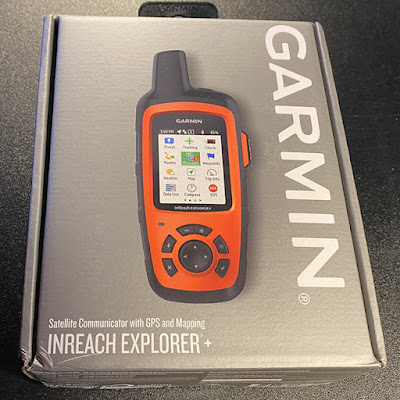
This PLB comes with me on all outdoor activities, locally and afar. Motorhome trips abroad; expedition tours to Costa Rica; going up onto Dartmoor or along the south west cliff coastline. It has allowed me to send messages home to loved ones when stuck up some tree lined steep narrow upper river tributary when dinghy camp cruising, I couldn't get smartphone signal.  Brilliant piece of kit. Adore it! 


I am sure you will already have much of this equipment. Remember you can use your kit DSLR and lenses with no problem to start off. Don’t compromise on your tripod or ball head though. Stability and sturdiness are key pre-requisites for successful night time photography.

In the next blog post I will explore:

1.       What advanced planning is needed to ensure success on the night?


Meanwhile, here are a few YouTube channels which really helped me start grasping the simple basics of milky way photography.  


and below, probably one of the best YouTube channels I have come across in a long time - absolutely amazing stuff


Saturday, 15 February 2025

Useful: Beginner's guide to useful apps for astrophotography

  Blogger isn't always the most intuitive platform to navigate - but it is free and simple to use and manage. 

To help you find information quickly on this blog, you can


Who knew my life would be ruled by apps? My smartphone is full of them – all neatly arranged in folders. A folder for motorhome apps; another for sailing. A big folder of apps for astronomy. Then smaller ones for car parking, entertainments, utilities, communications and more!  So much internal phone memory just for apps, but never mind.

You are here to find out about those apps that might be useful to you as you begin your learning journey in astrophotography; so, without further ado – here are the main ones I use and some others I don’t use but friends do.  I should say I have an android phone but I am sure you can get the ‘apple’ equivalent.

As I come across useful apps, I will update this page regularly with postscripts, so pop back every so often.


What is the aim of these apps? To help you get the most out of the night sky and/or to help you obtain the best nightscape/astrophotography images you can get!  

(As I always remind myself on every evening under the stars – my Google Pixel 6A has more computing power in it than the Lunar module had to get it down to the surface of the moon and back – or is that one of those urban myths we all like to tell ourselves?)

Before choosing an app – ask yourself these questions:

1. What do you need the app to do for you?

2. How popular is the app – how many downloads and what are the reviews like?

3. What are the alternative, comparative apps? How does your potential choice compare to the others?


The apps I use must do some of the following for me:

·        Give me Astronomy weather forecasts

·        Help me plan an astrophotography session

·        Provide Aurora, meteor and ISS pass alerts

·        Share interactive Star charts and databases on deep sky objects

·        Control my Asiair mini and my SWSA 2i tracker

·        Give me Moon phases and calendar information

·        (Control and align my telescope)

·        Find the position of Polaris on a polar clock

·        Provide a red light facility

·        Show detailed OS maps for night navigation

In essence, they all boil down to a few things – finding the right weather; finding the right location; finding the right shot. 

So here are some of the apps I or friends are using regularly for astrophotography:

SkySafari Plus  - if you are serious about astrophotography and astronomy – get Sky Safari 7, the paid version. If you are beginning, then get SkySafari Plus and decide whether to upgrade later. I use this app constantly. A huge database of stars, galaxies, nebulae and more to help plan your trips. Detailed observing lists. A quick search – gives you tonight’s best, planets, brightest stars, nearest stars, best deep sky objects and more. Hold it up to the sky and you know where you are looking instantly. Choose the type of celestial objects you'd like to observe (think galaxies, globular clusters or nebulas) then sort results by their location, to find the ones visible closest to where you are. Zoom in and out of the planetarium screen. You can use the time buttons to fast forward through the days and nights to see what is changing above your head. Simple and intuitive.

(SkySafari7 is the big brother of SkySafari Plus and it’s a paid for app. Largest database of any astronomy app, including every solar system object ever discovered. Accurate and with advanced planning tools and excellent telescope control options.)

Stellarium Mobile Plus – a paid alternative to SkySafari. There is a free version of Stellarium as well. Don’t use it myself but have friends to do and they highly rate it, describing it as comprehensive and immersive. A real-time based planetarium based app that shows you exactly what is above your head when you look up, just like SkySafari. You can control a telescope with it via wifi or bluetooth. It has AR star maps and the app uses your smartphone GPS. Huge database that includes high definition photographs like SkySafari. Easy to use, minimalist user interface and award winning. Not a great one for astrophotographer I think as it seems to be mainly used by my astronomer friends. But then I might be biased here – I am a SkySafari aficionado. 

PhotoPills App - a paid for app that is one of my most used. You drop a pin at your preferred location and immediately on the map appears the location, rise and set positions of the moon; the rising and position of the milky way core and much more beside. A great AR/AR night mode feature that allows you to work out where the milky way will be positioned in an image scene you are thinking of shooting later that night. Exact time, location, date and shooting position - brilliant as it helps me towards achieving that 'perfect' shot. Easy sections to calculate hyperfocal distance, field of view, exposure settings, star trails and more. One of my most useful apps - a game changer! Downside? steep learning curve - so use the help videos; works only in portrait mode. 

 Light Pollution map -  great for working out areas of light pollution in your locality - colour coded with teh ability to zoom in to detailed maps.  

Clear Outside - Created by First Light Optics and my first stop to find detailed weather forecasts for my night's observing. Cloud cover, wind speeds, temperatures, humidity levels and more. Updates hourly. You just input your location. Frustratingly, mine doesn't seem to be updating properly at the moment and I cant work out why.  

ISS detector app - great fun as it tells you when and where to look for the ISS passing overhead. Gives a notification a few minutes beforehand. With some basic weather information about the night's viewing as well. Love it!   


Telescopius - a new app to me and one I am still trying to work out. Essentially a planning tool it has a telescope simulator, calculator and a large deep sky objects database. You can save your frequently visited destinations. Check the weather for the oncoming days, use the simulator to work out the framing of your next astrophotography target in your camera. I suspect this will be another go to app when I have mastered its intricacies.   

Polar Clock - simple and easy to use. do your polar aligning, setting up of your equatorial mount and more. Owning a skywatcher star adventurer, it helps me check the position of polaris in its reticule. Use it every session. 


Discussion - Should you join a local astronomy club?

 Blogger isn't always the most intuitive platform to navigate - but it is free and simple to use and manage. 

To help you find information quickly on this blog, you can


Attending my first astronomy society meeting

I have been looking forward to this meeting of my local astronomy society which happens tonight. I have never been to an astronomy society meeting before and this one is special – the 60th anniversary of the society. A four-hour meeting at the University in the city centre (normally they are a couple of hours).

I have been to one or two of their outreach sessions – stargazing events down a local beach where society members arrived with telescopes, enthusiasm and knowledge – imparting joy, wisdom, awe, wonder and excitement to members of the public who turned up. Great fun and informative sessions – great learning opportunities too. Lovely evenings. 😊


Anyway, as I start to get ready for tonight - it has set me off thinking - what are the benefits of joining your local astronomy society? 

Now, I must be careful here, as I have only very limited experiences thus far. And as always, a caveat as well. How much you enjoy being part of a society will,  I suspect, probably depend, in no so part, on what kind of person you are and how you react to a ‘meetings/society’ environment. Perhaps its about the adage that sort of goes ‘getting out what you put in’ kind of thing.

I am somewhat ‘individualistic’. After thirty-five years sharing a small space with up to 150 students a day and meetings in the morning, lunchtime, after school and evening most days – I value my own space, me time, peace and quiet! I am very comfortable with my own company because I know I am 'boring and thick' so it doesn't come as a shock! 😆

 Don’t get me wrong, I’m not a loner. I enjoy being with good friends as much as anyone else. But, I am also one of those people who like to ‘learn on their own at first’ before joining groups. A slower way of learning, fraught at times and full of mistakes I know, but I like to try and get some of the basics and a little confidence in something before I engage with others in the subject. Its just a ‘typical me’ thing.  I wonder if other teachers suffer this?

Anyway, as my wonderful wife keeps reminding me, it’s good for my soul to be ‘sociable occasionally’. And, as always, she is of course, right!


So, the value of joining and participating in my local astronomy society?

I already know that this society is a community of like-minded, intelligent, smart astronomy enthusiasts. 

I’ve met a few down the beach; I’ve chatted with a few on the Facebook /messenger group pages. They like discovering things, pushing their knowledge development, and sharing it with others. That’s pretty clear. They seem keen to promote astronomy learning, research, and expertise. So, I am soooo looking forward to learning lots more from individuals and the monthly lecture programme. The one or two people I have met, have been passionate about astronomy, and to me that’s always a good sign. I get huge amounts of awe and wonder every time I go out at night. I suspect that it will get elevated through my interactions with others now. Bound to, and I find this quite exciting.

I pride myself on being a life-long learner; permanently curious! 

I know that to grow further in my knowledge of this amazing branch of science I have to ‘up my game’ now. Learning from others ahead of me in their learning journey is vital. Moreover, it’s fun! Simple quick tips, being kept up to date, pushed to learn or utilise something new. Some new ‘light bulb’ moments incoming, I hope. Some informal advice and mentoring deeply appreciated, if people have the time. Please, is there anyone who uses affinity photo regularly to improve their astro images? Please come and show me how to do masking and colour enhancing. I don't understand it. Its driving me nuts! 😥           Some members already share their projects and successes on the society Facebook page and I find these a great source of inspiration and learning. There are many really talented people out there. Great for us newbies.

How many mistakes have I made so far on my astronomy journey, because I didn’t join a society from the start? 

A poor choice of first astronomy telescope? Not getting to autoguiding more quickly in my astrophotography? All that time wasted trying to learn SIRIL, GraXpert and Affinity Photo the hard way – via YouTube tutorials? Argh! If only I had been a member of the society earlier so that I could have drawn on years of expertise! Lesson learned…painfully!

Networking, collaboration, sharing knowledge, learning from and with others. 

Astronomy is continually evolving and pushing the boundaries of scientific discovery and knowledge.  Through the beach meets, I have already met great advocates for astronomy. This seems to me to be the next logical chapter in my own astronomy learning journey; and at some point, maybe, I will reach a point, where I can then, with the permission of others, start giving back via public engagement events. That’s a little way off yet, but…sometime…..maybe…. I reach a point where I can safely and accurately share my astronomy knowledge and learning journey to those starting out. I’m a teacher – mentally programmed for it!

I don’t know whether my local astronomy society does this or not but a school’s outreach programme would always seem worthwhile supporting, although I accept it is probably very difficult to do in the current educational climate in the UK. Nigh on impossible I suspect! But, perhaps, in the future, that may be where my interest lies. I miss the witty banter of teenagers! Making complex astronomical thinking simpler and more accessible; sparking the imagination of young people who might become our future space scientists, astronomers and astronauts? Who knows – maybe in time. I’ve lots to learn before then!

One of the things I have always been fascinated in is citizen science type projects and I often wonder whether amateur astronomy societies around the country do that kind of thing? Collecting and sharing astronomy data with university departments? Is that a done thing?

I am also hoping that I can get opportunities to see and check out telescopes and accessories, their performances, advantages and disadvantages – a perusal of what members use regularly and why. 

As I have already discovered – ‘you don’t know what you don’t know’ but ‘knowing that you don’t know what you don’t know’ is a valuable first step! Society members insights and experiences in equipment choices and techniques will be valuable to my future learning and development in this hobby! Given that my favourite astronomy shops Rother Valley Optics and The Widescreen Centre are several hours road trip away – internet scrolling really isn’t that helpful! Perhaps there is also an opportunity to sell and buy second hand equipment from society members. At least I will know the person and have some support on hand as I get to grips with the new equipment! Mind you – I’ll have to get it past the family financial director first – SWMBO’d

And finally, I have set myself a target for this year. To occasionally go stargazing with someone else. 

It isn’t that I am lonely or anti-social but I know that occasionally sharing experiences with another like-minded enthusiast is actually a good, fun thing to do with the added advantage of safety in numbers – especially in new, remote and isolated dark sky sites on Dartmoor!


So here we are. Very excited. Really looking forward to the evening. Possible next chapter in my astronomy/astrophotography learning journey, on the horizon. I think I have summarised the potential benefits of joining your local astronomy society. I’ll let you know in a postscript how tonight goes, but I already know the answer – I will love it! I miss learning with others! And it will be good for my social interaction skills development - after all - all my social skills come from working with teenagers!  I'm not always sure that's a good thing! 😂


The day after the night before 

There was some confusion about start times for the evening - a Facebook post saying 5.30pm. An email saying 7.30pm. And so I was two hours early; the time passing pleasantly chatting to another soul who had also arrived early. The foyer of the University building has smart, comfortable seating areas and plenty of vending machines! 

Strange being back in a university room setting with rows of desks and two large screens each side of the room but exciting too. I'm a permanently curious geeky type - so new learning opportunities always grab my attention. 

The first presentation - a potted history of the society over its sixty years. Lots of achievements during this time. A rich history of public engagement within the city and its schools; a mobile planetarium visiting schools during the 1990's. Part of the 'Dark Skies' campaign movement; a monthly 'astronomy' column in the local paper. A monthly contribution to local radio. Library displays, a monthly newsletter. Not all of this happens now. I rightly or wrongly get the sense that the society membership is older; fewer younger members coming in and taking on roles. A surprise - Sir Patrick Moore was the society's patron from 1963 to 2012 and visited the city many times to do talks and outreach. This society has had and continues to have an impressive impact on promoting astronomy across the city. I came away with the impression that the society has achieved much over its sixty years due to the dedication of many of its members.  And there was clearly much expertise across the thirty or so people within the room last night. 

After feasting on a 60th birthday cake during a break there followed another lecture presentation of two parts - a monthly update of whats happening astronomically in our skies above. A description of Orion and its many deep sky objects; a potted history of the 'Space Race' from the early 60's to 2020. Some fascinating insights. 

I found it a thoroughly enjoyable and thought provoking evening. And I will certainly be attending next months meeting when there will be a focus on bringing along your own equipment, asking questions and learning how to set up your equipment to safely view the partial solar eclipse coming up at the end of this month. Someone will also be talking about their new Seestar 50 telescope - should be a fascinating evening! 


Wednesday, 12 February 2025

Review - Astronomy and Astrophotography books to help beginner's get started


Blogger isn't always the most intuitive platform to navigate - but it is free and simple to use and manage. 

To help you find information quickly on this blog, you can


What makes a good book for aspiring beginner astronomers and astrophotographers? 

Good question – well I think so! And its my blog! So here goes!


·        Easy to read style and simple, clear and concise language

·        Easy to understand – you don’t need oodles of prior scientific knowledge or experience to get the basic ideas

·        Useful practical information on all those simple tips that can make such a difference to your night time experiences e.g. using your fingers to estimate the distance between stars

·        High quality photos and simple descriptions to accompany them

·        Lots of examples to illustrate core ideas and principles

·        Aimed at people like me with basic beginner’s gear


So here we go. My take on useful books for beginner’s. There are not in any order of preference etc. I will add to this list as and when I come across a book that I think fits my criteria above  - so do pop back occasionally 

‘Turn Left at Orion: Hundreds of Night Sky Objects to See in a Home Telescope and How to Find Them’        By Guy Consolmagno and Dan M. Davis

Format: Available in paperback, e-book, or spiral-bound

Print: Glossy black & white pages for bringing to the field

Mine is looking a little dog-eared isn't it? 

The first book I got on the subject. And I adore it. It comes with me on all astronomy observation sessions with my bigger telescope. It goes on every motorhome trip. Recommended to me by the team at First Light Optics as a good starter book when I purchased my Skywatcher Star Discovery 150i WIFI GOTO telescope. The book describes how objects will appear with simple telescopes and binoculars; what impact light polluted skies will have on the object being viewed compared with viewing from dark sites. Clear simple diagrams, concise text and arranged in a format which helps the beginner learn how to navigate the night sky in a sensible, effective fashion. With a mixture of easy to find objects and then more challenging targets, you can actually ‘grow’ with this book. And the mixture is good – galaxies, nebulae, star clusters, double binary stars. I’m never bored dipping into this book and it is always on my desk when planning an observation session.


One last point – the paper is glossy and withstands dew! Its spiral bound and slightly bigger than A4 in size. Basically it withstands a night outside!


‘Signposts to the Stars: An Absolute Beginner’s Guide to Learning the Night Sky and Exploring the Constellations’    by Richard J. Bartlett        Print: Black & white

Although I don’t have this book in my collection, it has been recommended to me. Essentially the book uses simple language, constellation maps, practical tips, stories about ancient myths and history to give a tour of our night sky, starting with the brightest, most easily identifiable constellations that you can see with binoculars or the naked eye. Basically, a detailed guide on how to find the constellations and features within them with easy-to-read maps.


‘Stargazing: Beginners Guide To Astronomy’   By Radmila Topalovic and Tom Kerss, Astronomers at the Royal Observatory Greenwich.

Publisher: Royal Observatory Greenwich    ISBN: 9780008196271       Paperback

I have this one in my collection but have loaned it out to a nephew. I must get it back at some stage. Aimed squarely at those beginning their astronomy journey. From telescope and binocular choice to planetary information, seasonal star charts and advice on how to plan your stargazing, the book covers lots that a beginner would want to know. It was one of the first books I picked up when I first considered a new hobby – astronomy and astrophotography – just after I retired. I got it along with another book ‘Collins Guide to the night sky’. Both obtained from the shop at the Royal Observatory, Greenwich, on a London visit. Anyway, I liked the simple clear language, informative diagrams and photos.


‘Collins Guide to the night sky – A month by month guide to exploring the skies above Britain and Ireland’   Publisher Collis and Royal Observatory Greenwich.

I have got one of these books every year since I started the hobby and it forms part of any astronomy/astrophotography session planning I do. Essentially it is a month-by-month guide to the planets, stars and constellations you can each night in a month across a year, from the northern hemisphere. A mixture of clear concise text, calendar lists, celestial charts and diagrams help me map the movement of the stars and the moon cycle over the month.  


‘Moongazing – Beginner’s guide to exploring the moon’   By Tom Kerss   Publisher: Collis and Royal Observatory Greenwich

Another from the Collins ROG stable which I really like and refer to often. Detailed moon maps, the history of lunar observation and exploration; what the moon is made of and more. How to draw moon sketches, choosing a telescope to observe the moon, and a comprehensive section on astrophotography tips and skills for moon photography. I learned loads about eclipses and blue moons! And finally understood what is meant by ‘conjunction’ and ‘occultation’! The photographs are fascinating. I love the lunar atlas bit – photos an accompanying maps in two page segments – details about surface features. With my smaller table top dobsonian, I can see some moon gazing nights materialising during the summer when we are motorhoming. I have yet to do much lunar observation or astrophotography but when I do, this book will be an excellent starting point.


‘Guide to imaging the moon’   by Dave Eagle FRAS    www.star-gazing.co.uk  Paper back

Another book I picked up but haven’t fully used yet. Dave has produced a series of guides – I have a few and will list them below. In this guide he covers DSLR and webcam imaging of the moon. From imaging to stacking them, techniques on noise reduction and sharpening, its practical with good step by step tips and techniques. He refers to using Autostakkert, Registax and photoshop for image processing.  Moon astrophotography is on my list of things to start exploring this year.


‘The Backyard Astronomer's Guide’    by Terence Dickinson and Alan Dyer

I’ve been told to add this book to my collection soon. Why? Simple clear and concise information – from choosing a telescope to capturing the cosmos! Stunning images and stellar advice on choosing astronomy equipment. Sky tours, star charts and more. Latest edition is bang up to date on observation techniques and equipment and has five brand-new chapters, including three essential essays on binocular, telescope and Moon tours by renowned astronomy writer Ken Hewitt-White. From LED lighting technology, WiFi-enabled telescopes and the latest advances in binoculars, telescopes and other astronomical gear to new techniques for observing the Sun, the Moon and solar and lunar eclipses. And new sections on dark sky reserves, astro-tourism, modern astrophotography and mobile phone astrophotography.  It is on my wish list!


‘Photographing the night sky – Techniques, planning and processing’    by Alyn Wallace

Publisher – www.fotovue.com

The most expensive book I have ever purchased and worth absolutely every single penny, a thousand times over!  I can’t begin to sum up what an influence this book has been on my skills development. Comprehensive – an inadequate summary! If you are a beginner to landscape astrophotography, then this is the book for you! 

Detailed, informative, highly readable. Stunning photographs and illustrations. Clear, concise explanations – nothing overwhelming but everything aimed at you assimilating and understanding concepts quickly. Is it an encyclopedia? Yep, think so! From equipment, settings and multiple exposure techniques to astronomy basics, location scouting and photo post editing techniques, I am always referencing some chapter monthly! Complex topics explained in an easy to grasp manner have had immediate impact on my milky way landscape images. Is it making me a better night time landscape imager? Absolutely!


‘Night sky photography – from first principles to professional results’   by Adam Woodworth  Publisher: Octopusbooks/Illex Press

Another book which has taught me so much! And a book I constantly dip back into regularly. This is a book, that like Alyn’s above, takes you through everything you need to know – step-by-step. From what gear you need to simple techniques to master when out in the dark. I like his post editing workflows – they have helped me enormously. The book is well written and easy to understand. Explanations are simple, concise, informed and well-paced. Stunning photographs throughout. Heavily milky way focused but that is what I wanted. There are sections on shooting the northern lights as well. From gear to software, settings to post editing techniques – this book is great for beginners to nightscape astrophotography.


‘The Stargazer’s Handbook – The definite field guide to the night sky’  By Giles Sparrow  Publisher: Quercus books

I love this book. I pick it up in my quiet downtime moments just to browse. It is a first port of call when I am looking for new deep space objects to capture.   Complete maps of constellations and celestial bodies. Month by month guides. Beautiful, extraordinary photography – over 400 images. You take this book out with your binoculars on those warm, clear nights! Every star, constellation and nebula is fully illustrated and comes with a detailed annotated star chart. Infact, what I like most, is it is completely arranged by constellation. Love this book.


‘Nightwatch: A Practical Guide to Viewing the Universe’    By Terence Dickinson

This is a book that is a general introduction to astronomy. And its on my Christmas list for 2025. Although up to now, I have focused on my astrophotography, I know it is time to start exploring the astronomy side of things more.

Anyway, this book has been recommended to me. Stunning photographs, charts of famous stars to seek out with binoculars or small telescopes. Useful equipment section as well. Clear, concise and simple language make it an easy read. Explanations are relatable, easy to follow an understandable.  Great sections on the moon and planets. Even a chapter on astrophotography and sections about the latest digital computerised smart telescopes. A huge amount of information condensed into bite sized chunks. 


Tuesday, 11 February 2025

Technique tutorial: Beginners guide to keeping an astrophotography/astronomy log book

Blogger isn't always the most intuitive platform to navigate - but it is free and simple to use and manage. 

To help you find information quickly on this blog, you can


Well, some people do. Others don't. Which are you?

I'm the former - I keep notes on everything. I have hundreds of used notebooks upstairs in my study - all the ones from when I was a teacher. Then there are my note books for the various blogs and YouTube channels I have.  Don't fret for me - I only have one on the go at any one time. But I keep hold of them - no idea why, but there we go!  

So, the big question - 'What's the point of keeping an astrophotography and/or astronomy notebook?' 

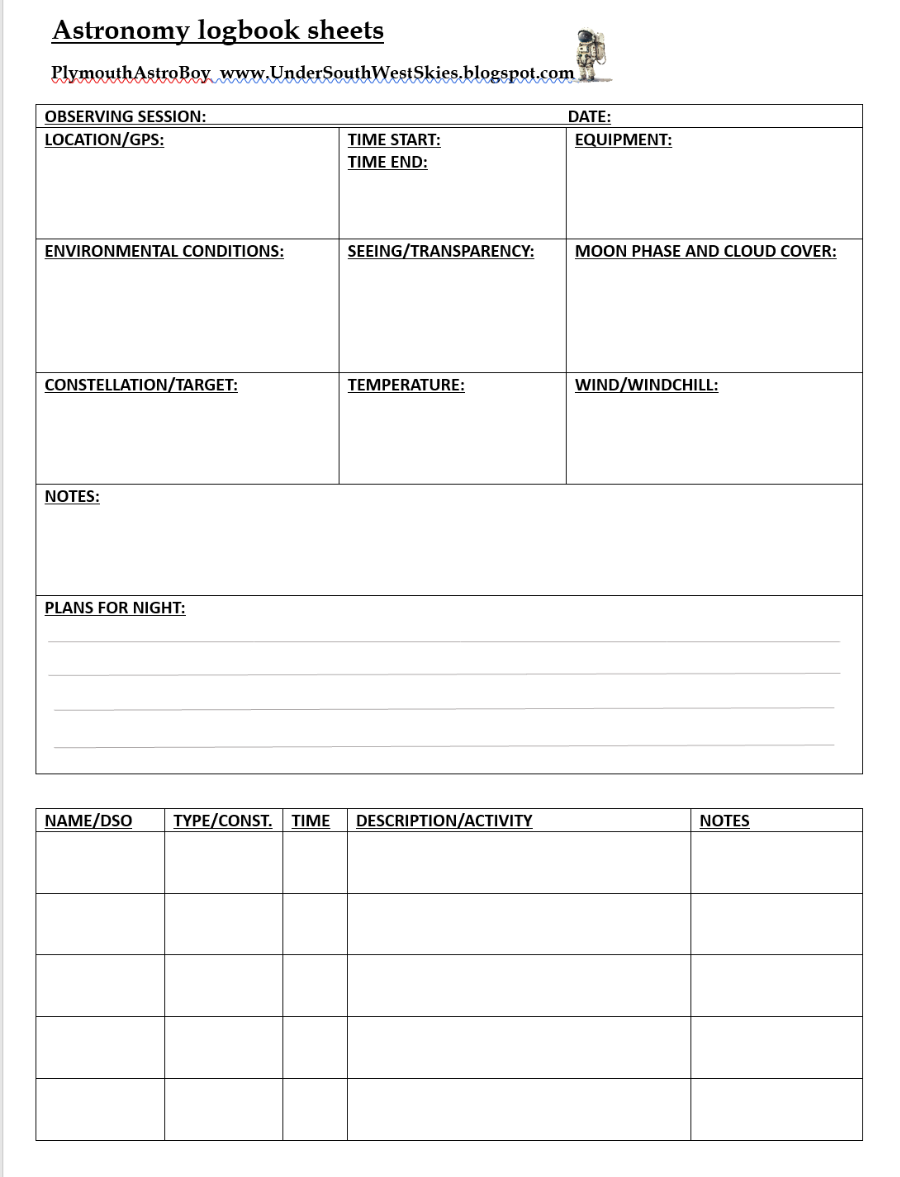
Page 1 of 2 that I use in my Astronomy log book 


Memories! Developing one's observation skills - of the night sky; of the weather; of the activities done by myself and with others. 

A diary of your experiences and learning journey (normally why I keep a logbook of some form). What you have done, seen, learned! How you have grown in skills and understanding. What you achieved and how you felt on those cold nights when your rig frosted over and you lost contact with your hands and feet.  A memory bank - what the first deep space object was that you saw and drew all those years ago! Big picture overview details easily remembered; little picture minutiae details, easily forgotten. A record of deep space objects observed that you can return to easily and compare notes from a more recent observation session against. What's changed? How have your viewing skills since last time improved? 

Page 2 of 2 for my Astronomy log book 


My dinghy cruising blog, for example, ran for fifteen years with many subscribers and tens of thousands of page views every year. I kept a dinghy cruising log book of every single time afloat. My dinghy cruising YouTube channel - a visual diary of fifteen years afloat through over 270 odd videos. stories, adventures, skills development, personal reflections, hardships, accidents, capsizes, successes, wildlife encounters - all there as memories. 

This was how my astronomy log book started out way back in 2021

Above are my astronomy log book pages. I could buy one but I just made up my own and I print them off as and when and then stick them into a big spiral bound A4 book. I think they get most of the details of what I want to record. I can expand on some details e.g. mentioning fog, dew, pollution, turbulence etc. Encounters with wildlife - recently its been foxes, hedgehogs, sheep and wild ponies!  Starlink satellite chains! 

There are appropriate places in which to record note about DSO's - RA and Dec details, brightness, constellation details etc. 

Anyway, hope these help. I am sure there are software programs that will do it but I'm not one for those. I gain greater enjoyment from writing during the observation/astrophotography night. 


My astrophotography log book is hand written as and when I go out

With regard to my astrophotography logbook - it's more a jotter than a log book. Similar things get written in - a plan for the night; shooting details e.g. how many lights, at what exposure length etc. 

I guess that over the years I will build up a series of these to look back over, which will be fun. 

If you have a particular design for your log book why not share the details with us  - drop us a comment below.